Etekcity laser Grip 774 - Infrared THermometer
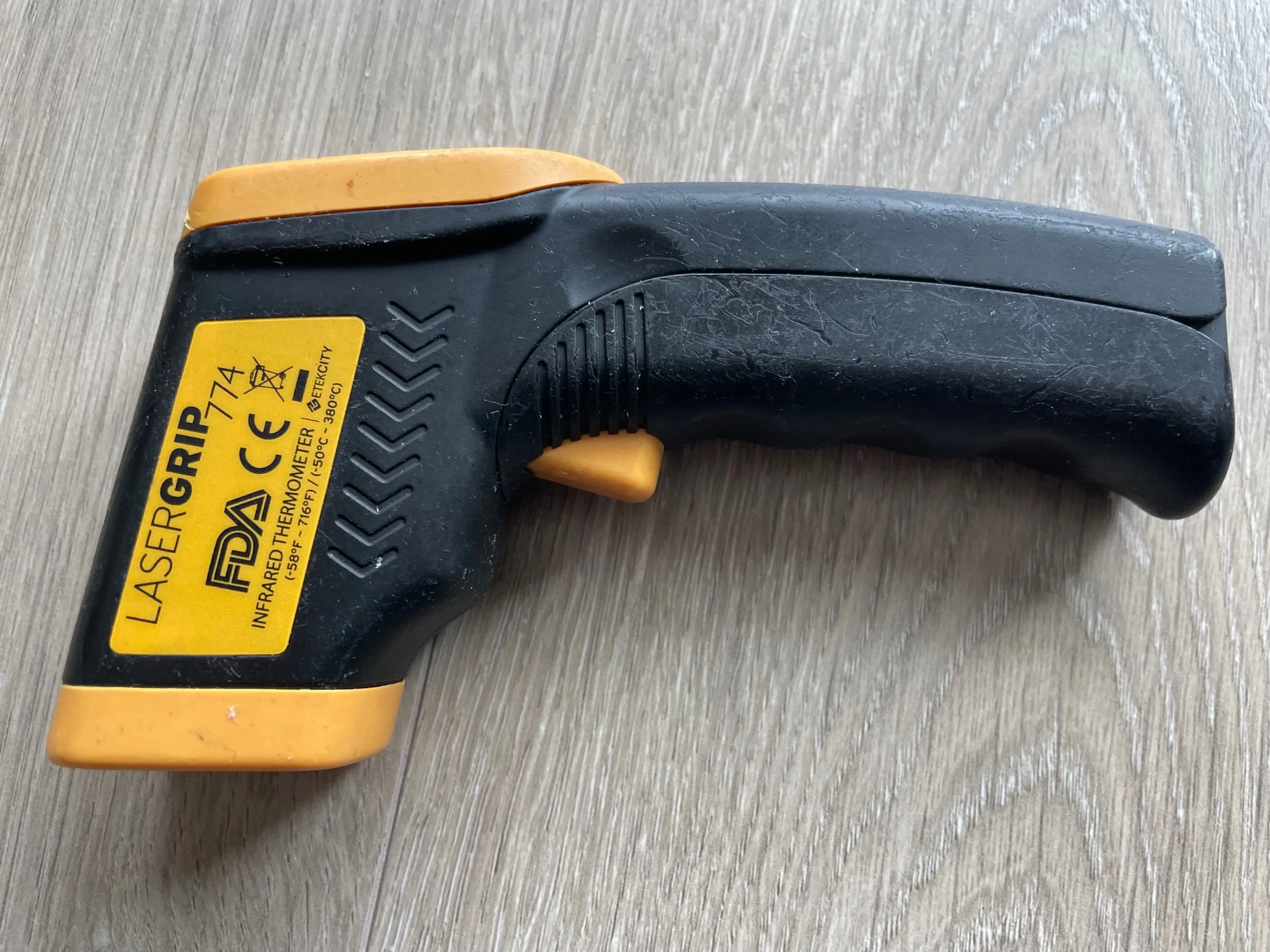
No hover, no hand, no excuses.
The Run Card
There's a version of the thumb test for pans and grates too: hover a palm a few inches over the surface and count how long you can stand it. One-Mississippi, two-Mississippi. It's the hand-hover method, and I did it for years before I owned this thing. It works, sort of, the same way the thumb test works — it's a skill, not a measurement, and it tells you "hot" without ever telling you a number.
And the number is the whole job. A cast iron pan that looks ready and a cast iron pan that's actually at 450°F for a proper sear are two different pans, and your hand can't tell you which one you're holding. This is the same size-up problem we run on every call before committing a crew: read the conditions before you commit; don't commit and then find out. The Lasergrip 774 is how I size up a cooking surface before a single piece of protein goes anywhere near it.
THE TOOL
Point, pull the trigger, read the number. That's it. The laser dot shows you exactly where the sensor's actually looking, so you're not guessing whether you just read the pan or the burner ring next to it. Squeeze it, and you've got a surface temperature in under half a second, from a comfortable distance, without ever putting a hand near something that could put you in the ER on a day off.
The range runs from deep-freezer cold up past 700°F, which is more headroom than you'll ever actually use at a stove — but it means the same tool that checks your seasoning oil can check the inside of a smoker or a hot exhaust manifold without blinking.
This particular unit has been dropped on tile and checking griddle temp at cook-offs more than anything on a spec sheet. It still reads true. It won't win a beauty contest — the label's scuffed and the housing's got the scars to prove it's been to work — but that's the same standard I hold everything else in the kitchen to: it doesn't need to look new; it needs to still be right.
One thing worth saying plainly, because the label says it too: this reads surfaces, not people. It's built for pans, grates, oil-slicked flat tops, and engine blocks — not skin, not the inside of a chicken breast. For that, you still want a probe thermometer like the Thermopen One. This tool answers a different question: not "is it done," but "is the surface actually ready to cook on."
THE TACTIC
Here's the part nobody puts on the box: infrared thermometers don't read every surface the same way, and the surface you actually want to check — a shiny, oiled flat top — is the one they're worst at. Shiny and reflective surfaces bounce more of their surroundings back at the sensor than they give up their own heat, so the number on the screen drifts low. Point it straight at a pool of oil or a mirror-polished pan, and you'll get a reading that's confidently wrong.
Matte, dark surfaces don't have that problem. Seasoned cast iron, a matte griddle top, the grates themselves — those read true. So my actual method is: read the pan or the grate, not the oil sitting on top of it. If I need a shiny surface checked, I'll lay a strip of matte tape on it first and read that instead — same trick line cooks use to get a real number off a mirror-finish flat top.
Distance matters too. This thing is built to read a spot about an inch across from roughly a foot and a half away — stand back further than that and you're not reading the pan anymore; you're reading an average of the pan and everything around it. And a griddle or cast iron surface isn't one uniform temperature to begin with — there are hot spots near the burner ring and cool spots at the edges, same as a room during a structure fire has pockets that don't match the average. Three or four reads across the cooking surface, at the right distance, tell you where you can actually put food and get the sear you're planning on.
AFTER-THE-FIRE CRITIQUES
It reads surfaces, not doneness. Pair it with an instant-read for the protein itself — this tool tells you the pan's ready, not the chicken.
Shiny surfaces lie to it - and they lie low. Polished metal and pooled oil have low emissivity, so a direct read undersells the real temperature. Read matte cast iron and dark griddle tops straight; for a mirror-finish pan, lay down a strip of electrical tape (or a dab of flat paint) and read that instead.
Get close enough to trust it. Stand too far back, and you're averaging more surface than you meant to read — keep it to around a foot and a half out (roughly 14 inches) for a real spot check.
It's a temperature gun, not a toy. Never point the laser at eyes, and never at people or pets — the manufacturer means it, and so do I.
Check the 9-volt before the shift, not during it. It shuts itself off after fifteen seconds to save the battery, which is generous of it, but a dead battery mid-sear isn't.