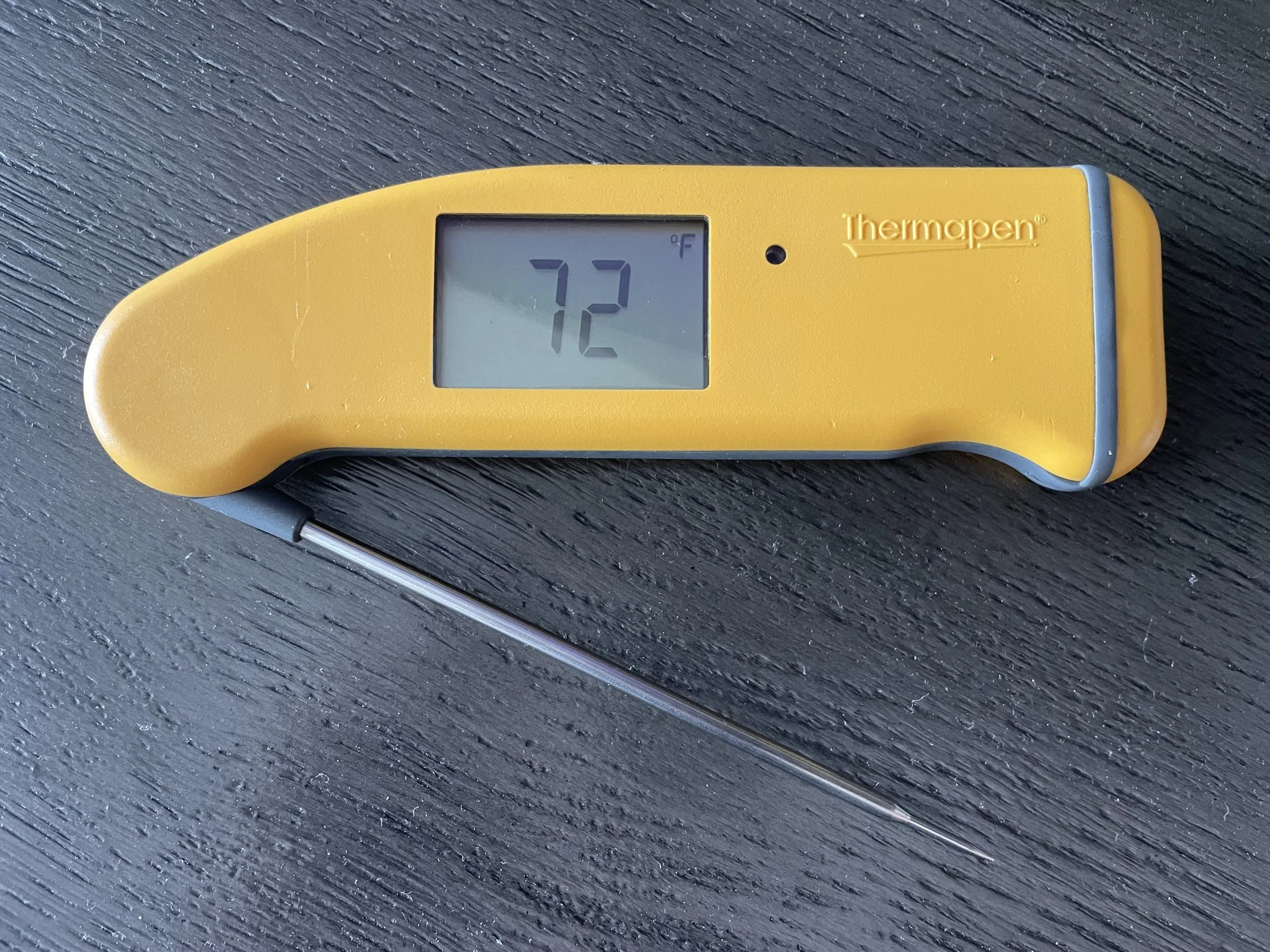
Thermapen One
THE RUN CARD
Many a professional chef can be seen using the thumb test — tactical touch — or a cake tester, that thin metal pin, when checking a protein for doneness. I'm a practitioner of the thumb test myself. There may even exist a video of me professing its use on national television. I'll let you go looking for that one.
But here's the thing about the thumb test: it's a skill, not a measurement. And I've never trusted a skill to be as repeatable as a number. It's the same reason I weigh ingredients instead of eyeballing them — grams don't have an opinion, and neither does a thermometer. If I want the same result twice, I need the same input twice, and "it felt about right" isn't an input.
What I actually care about isn't just "is this done." It's thermal carryover — how many more degrees a piece of protein is going to climb after it comes off the heat, weighed against how much rest time I've actually got before a hungry crew starts circling the pass. Those two numbers have to match, or somebody's eating something gray in the middle or cold on the plate. That math only works if the number going in is real. The Thermapen ONE is how I get that number, every time, in the field.
THE TOOL
Forget the spec sheet. Here's what matters: it reads in one second, and it's right — within half a degree, every time. You touch the probe to the protein, and you've got a real number before you've had a chance to second-guess it.
The rest of it just doesn't fail. Drop it, rinse it, run it through a dozen checks back to back without babying it — like a Thermal Imaging Camera (AKA- TIC) that gets scraped along the ground while advancing a hose line down a burning hallway, it doesn't care. That's the actual standard here, the same one you'd hold anything else on the rig to: not "usually works," just works. It runs right-side-up no matter which hand grabs it, lights up in the dark without being asked, and goes about two years on one battery before you think about it again.
It costs more than a thermometer has any business costing. But a tool that's slow or wrong costs more than that — in a ribeye you overcooked waiting on it, or six other things that went cold while you stood there guessing.
THE TACTIC
Here's where the thermal carryover math actually earns its keep. Every protein keeps cooking after it leaves the heat — how much depends on mass, starting temperature, and how hot it was cooking. A thick roast can climb 15°F or more during rest. A thin chicken breast might only climb 3–5°F. If you don't know that number for what you're cooking, you're either pulling too early and gambling, or pulling at target and overshooting once it rests.
Under normal circumstances, that's a "get to know your equipment" problem you can solve with a few dry runs. Under a waiting crew, it's a scheduling problem — you don't always get to choose when the rest period happens, because it's also whenever everyone actually sits down. So I work backward: I know roughly how long I've got before the crew's actually eating, I know the carryover range for whatever I'm cooking, and the Thermapen ONE gives me the one real variable in that equation — the actual number, right now, not a guess. Pull temp becomes a calculation instead of a hope.
AFTER-THE-FIRE CRITIQUES
Calibrate it once when it arrives, even with the NIST certificate — ice water should read 32°F. Takes thirty seconds, buys you confidence for the life of the tool.
Don't chase the display while it settles. The one-second read is real, but give it that full second before you trust the number — pulling it too fast is the most common way to get a bad reading with any instant-read.
Different cuts, different carryover — get a reference. I keep a reference matrix for specific cuts (i.e., beef) to help predict carryover by protein and thickness, rather than relying on memory mid-shift.
Probe placement still matters more than the thermometer. The fastest, most accurate thermometer in the world still reads wrong if it's sitting in fat or touching bone. The tool doesn't fix technique — it just tells you the truth about it.