Ultra-Light Chocolate Mousse
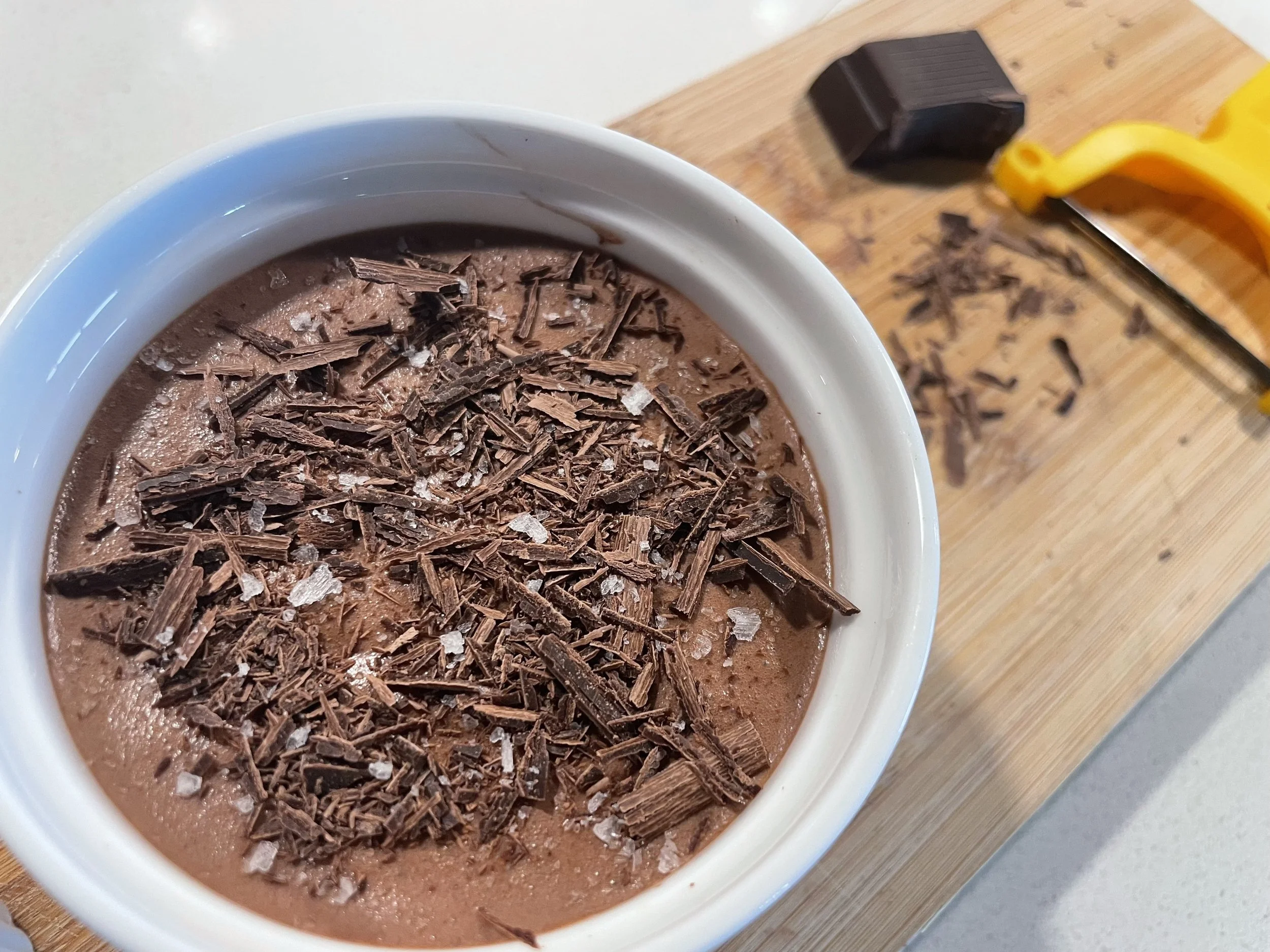
Milk Street pitches this one on a Parisian bistro pedigree — a chocolate base lightened with whipped egg whites instead of cream, meant to land somewhere between mousse and air. No cocoa powder, no gelatin, no shortcuts. Just chocolate, half-and-half, butter, yolks, and five whipped whites doing the heavy lifting. That's a bold structural bet for a dessert with zero stabilizers, and I wanted to see if it holds the line past the photo shoot.
Adapted by Rose Hattabaugh, Milk Street — "Ultra-Light Chocolate Mousse"
FUEL
6 oz bittersweet chocolate (60–65% cocoa solids), finely chopped
2/3 cup half-and-half
4 tbsp salted butter, cut into pieces
Pinch of table salt
2 large egg yolks
5 large egg whites, reserved separately
2 tbsp packed light or dark brown sugar
1/2 tsp cream of tartar
Milk, semisweet, or bittersweet chocolate bar, for shaving
Pinch of flake salt
TOOLS
Heatproof large bowl
Small saucepan
Stand mixer or hand mixer with whisk attachment
Second clean large bowl (if hand-mixing whites)
Silicone spatula
Whisk
Serving dish or ramekins
Vegetable peeler
TACTICS
Simmer the half-and-half, butter, and salt together, then pour it hot over the chopped chocolate and let it stand for 2 to 3 minutes. Whisk until smooth, let it cool to warm — not hot — then whisk in the egg yolks and cool the base to room temperature. Separately, whip the egg whites with the sugar and cream of tartar on medium until they hold droopy peaks, about 3 to 4 minutes. Fold a third of the whipped whites into the chocolate base to loosen it, then fold in the rest with a whisk until no streaks remain and the mixture resembles melted ice cream. Transfer to a serving dish or ramekins, cover, and chill for 4 to 12 hours. Finish with shaved chocolate and a sprinkle of flake salt before serving.
MODIFICATIONS: Except for the flake salt, none. Ran it as written, ingredient for ingredient, step for step.
The technique hinges on one call: whip the egg whites to "droopy peaks" — short of stiff, past soft. That's a narrow window, and the recipe doesn't give you much to check against beyond what you see. I worked it on medium the full time as instructed, watched for the melted-ice-cream consistency in the final fold, and hit it: no streaks, right pourability, textbook fold.
Chocolate flavor was clean and direct — not too sweet, not too rich, exactly the "pure chocolate" pitch the recipe makes. Texture out of the fold was genuinely light. On that front, this recipe delivers exactly what the name promises.
AFTER-THE-FIRE CRITIQUES
Here's where it fell short of the call: separation. I ran two chill tests — 5 hours and 24 hours — and both produced the same result. A thin layer of liquid pooled at the bottom of the ramekin by the time I got a spoon in. Not a lot, but enough to notice on the first bite, and it didn't resolve itself with more time in the fridge. If anything, 24 hours confirmed it wasn't a "give it longer" problem.
I hit the texture target on the fold. The separation showed up downstream of that, at rest — which points more at the base's structural stability than at my whipping technique. Whether that's an inherent limit of an egg-white-only lift with no cream or gelatin backing it up, or a tighter tolerance window than "droopy peaks" accounts for, I can't say for certain from one test cycle. What I can say: the recipe as written doesn't flag it, and it happened both times, unmodified.
Flavor and texture at the moment of serving earned this recipe real credit. The separation is the reason it's a 3.5 and not higher — a mousse that needs to be eaten immediately to look like the photo isn't fully solved yet.
Indulge.