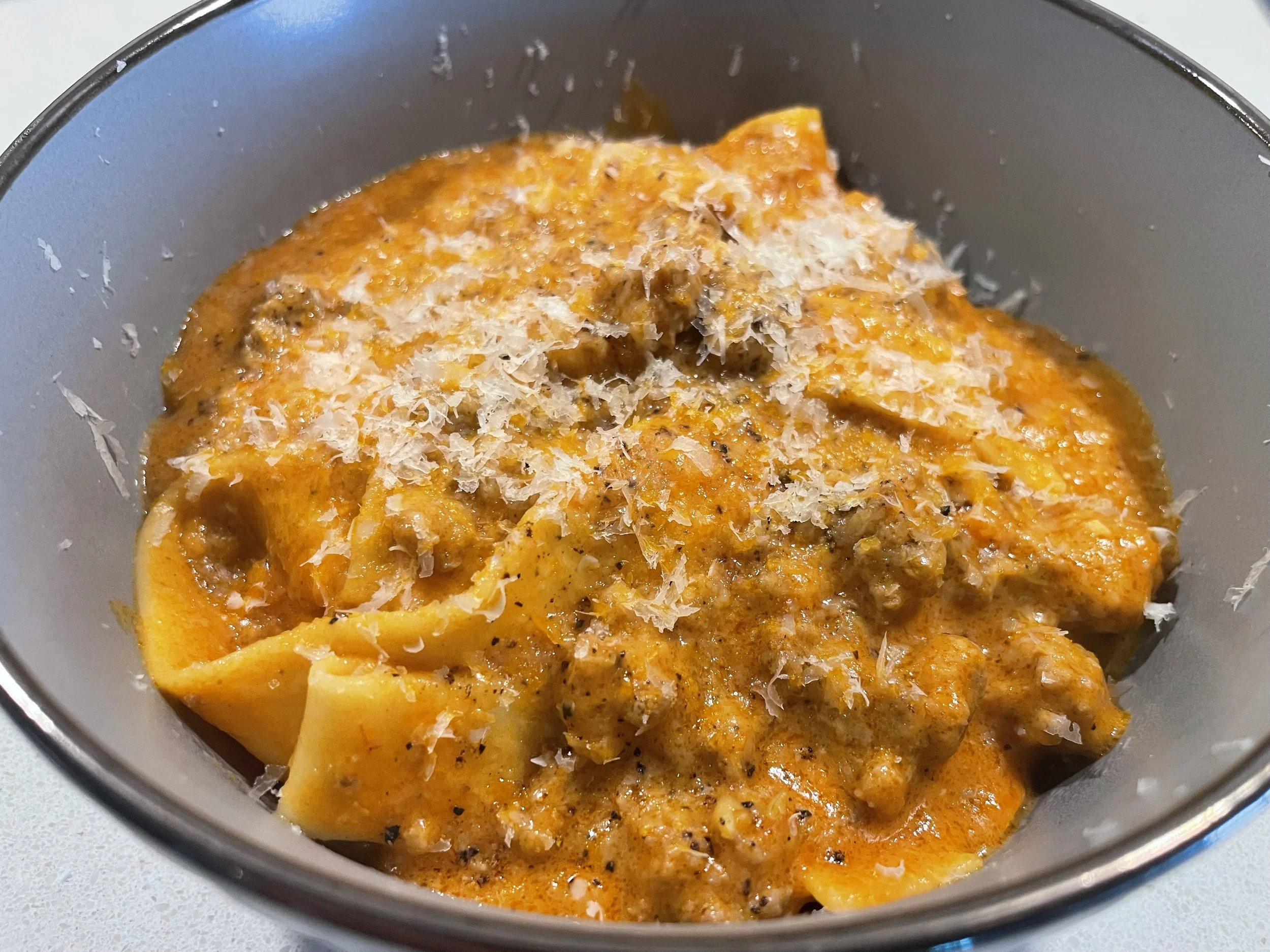
Tuscan ragù - Pappardelle Strascicate
I've never run a marinara call. Spaghetti, lasagna, baked ziti — hallowed ground for most firehouse cooks, but never mine. Not for lack of respect. I just never built the attachment. Grew up in California with a taste for Latin and Asian flavors, not red-sauce Italian. Moved closer to Italy by mileage — Georgia — and the South's own food tradition didn't push me there either.
Then I spent three weeks in Italy, and that position changed hard and fast. Pasta in every shape, size, and sauce made me want a real landing spot for the firehouse rotation — something that splits the difference between lasagna and bolognese. A ragù built on a long, slow cook, wine (or beef broth if you’re at the station), milk, and flat noodles made for dragging through a spoon, carrying a lasagna-grade flavor profile. Besciamella and all.
What follows is my take on a Tuscan ragù.
Adapted from Lawman Johnson's Penne Strascicate for Christopher Kimball's Milk Street.
Fuel
For the Ragù
¼ cup extra-virgin olive oil
2 medium carrots, peeled and finely chopped
2 medium celery stalks, finely chopped
1 medium red onion, finely chopped
Kosher salt and ground black pepper
8 ounces 80/20 lean ground beef
8 ounces ground pork
½ teaspoon baking soda
1 teaspoon coriander seeds, crushed
1 teaspoon fennel seeds, crushed
¼ teaspoon ground cinnamon
¼+ teaspoon freshly grated nutmeg (for ragù and besciamella)
6-ounce can tomato paste (⅔ cup)
4 medium garlic cloves, finely chopped
½ cup dry white wine or beef stock when at the firehouse
½ cup milk
2 bay leaves
For the Besciamella
1 tablespoon salted butter
1½ tablespoons all-purpose flour
1 cup half-and-half
½ teaspoon salt
Grated nutmeg to taste
1 ounce Parmesan cheese, finely grated (½ cup)
For the pasta and serving
1 pound pappardelle
Kosher salt
Finely grated Parmesan cheese, to serve
Tools
Large Dutch oven
Small saucepan (for besciamella)
Whisk
Large pot (for pasta)
Colander
Microplane or fine grater (garlic, nutmeg, Parmesan)
Tactics
Place a Dutch oven over medium-low heat. Add the oil, carrots, celery, onion, 1 teaspoon salt, and several grinds of black pepper (roughly ½ teaspoon). Stir often for 25 to 30 minutes until fully softened with no color on the vegetables.
Bump the heat to medium. Create a well in the middle of the cooked soffritto and add the coriander, fennel, cinnamon, and nutmeg; stir to combine. Add the beef and pork, salting both. Break the meat down as it cooks, add the baking soda, and cook for 5 to 7 minutes, or until no pink remains and some browning occurs. Add the milk and cook until evaporated, 3 to 5 minutes. Add the tomato paste and garlic; cook for 2 minutes until the paste slightly darkens. Add the wine (or beef stock), scrape the pot, and cook off almost all the liquid, about 2 to 3 minutes.
Add 3 cups water and the bay leaves. Bring to a simmer over medium-high, then drop to medium-low. While uncovered, stir occasionally, cook for 30 to 35 minutes until the meat is tender and the liquid is reduced by about half. Taste for seasoning; add more salt if needed.
Place a small saucepan over medium heat. Melt the butter, whisk in the flour, and cook for 2 minutes, stirring constantly. Whisk in the half-and-half gradually, add a ½ teaspoon of salt, bring to a simmer, and cook 3 to 4 minutes until thickened and the raw-starch taste is gone. Off heat, stir in the Parmesan and a few grates of nutmeg. Taste for salt; add more if needed. Set aside. It’s ok if it seizes; it will be blended in the warm ragù later.
About 20 minutes into the ragù simmer, start boiling 4 quarts of water. Add the pappardelle and 2 tablespoons salt. Cook well shy of al dente — start checking 3-5 minutes before package time. I stopped cooking at 3 minutes for my particular pappardelle.
Pull the bay leaves from the ragù. Stir in the besciamella, and cook for 2 minutes over medium-low until slightly thickened. Add the pasta gradually, stirring to coat and break up clumps. Keep dragging through the sauce for 2 to 3 minutes until the pasta hits al dente. Off heat, taste, and adjust salt and pepper. Finish with Parmesan and flake salt. Indulge.
AFTER-THE-FIRE CRITIQUES
I ran the search wide before landing here — ATK, Williams-Sonoma, Marcella Hazan, Michael Chiarello, and Samin Nosrat, who lived in Florence long enough for it to show in her cooking. Milk Street's version won out, built on Florence chef-owner Alessandro Gozzi's own recipe, and it rang truer to Tuscany than the rest of the lineup.
Two changes made the cut. Baking soda goes into the meat first — it raises the pH, which helps the browning and keeps the meat from seizing up and losing liquid. Then the meat braises in milk, a nod to the region's own tradition. The mild lactic acid and calcium break down tough proteins without toughening the meat, so lean cuts stay tender, and as the milk cooks down, the dairy sugars caramelize into a faint nutty sweetness that cuts the gaminess. Don't skip it. It's what pulled the sauce into balance.